Chronoscape
A speculative app that tracks your subjective sense of time — and uses the gap between clock time and felt time to support focus, rest, and self-awareness.
↓Skip to solutionContext
The Figbuild brief challenged designers to track something intangible and previously unmeasurable about human sensory experience — and design a speculative tool to manipulate it in support of better health and self-understanding.
We chose mind-wandering — the natural human phenomenon where attention drifts from the environment toward thoughts and imagined scenarios. It’s invisible, unmeasurable by any existing tool, and deeply tied to our sense of time. The sensory thread that connects them: chronoception, our internal sense of duration.
Where we began
47% of waking hours — and no tool to understand them.
Research suggests humans spend about 47% of their waking hours thinking about something other than what they’re doing. Despite this, modern technology only tries to eliminate that distraction — not understand or work with it.
That’s the gap. Daydreaming plays a documented role in creativity, problem-solving, emotional connection, and mental restoration. But for people with depression, ADHD, or chronic stress, mind-wandering doesn’t go well — it becomes rumination, anxiety, repetitive negative thinking. No tool exists to help people tell the difference in real time.
.jpg)
What we found
The transition itself was the real problem.
When your internal body state is dysregulated, your mind wanders — and your perception of time warps. This is chronoception impairment: a broken internal sense of duration. People don’t realize how much time passes when they drift.
For people with ADHD, the movement between focused and unfocused states is completely uncontrolled and often destabilizing. There is nothing that makes that transition safe, intentional, or legible.
The gap between tasks — no dopamine, no incentive, no motivation — is a no-man’s-land that existing tools ignore entirely. Nobody was working with the internal sensory experience of the transition itself: the felt disorientation, the reward withdrawal, the emotional stuck-ness.
Solution
What if the gap was visible?
Chronoscape makes the transition between focused and unfocused states legible — so you can move through it intentionally and land softly on the other side.
01
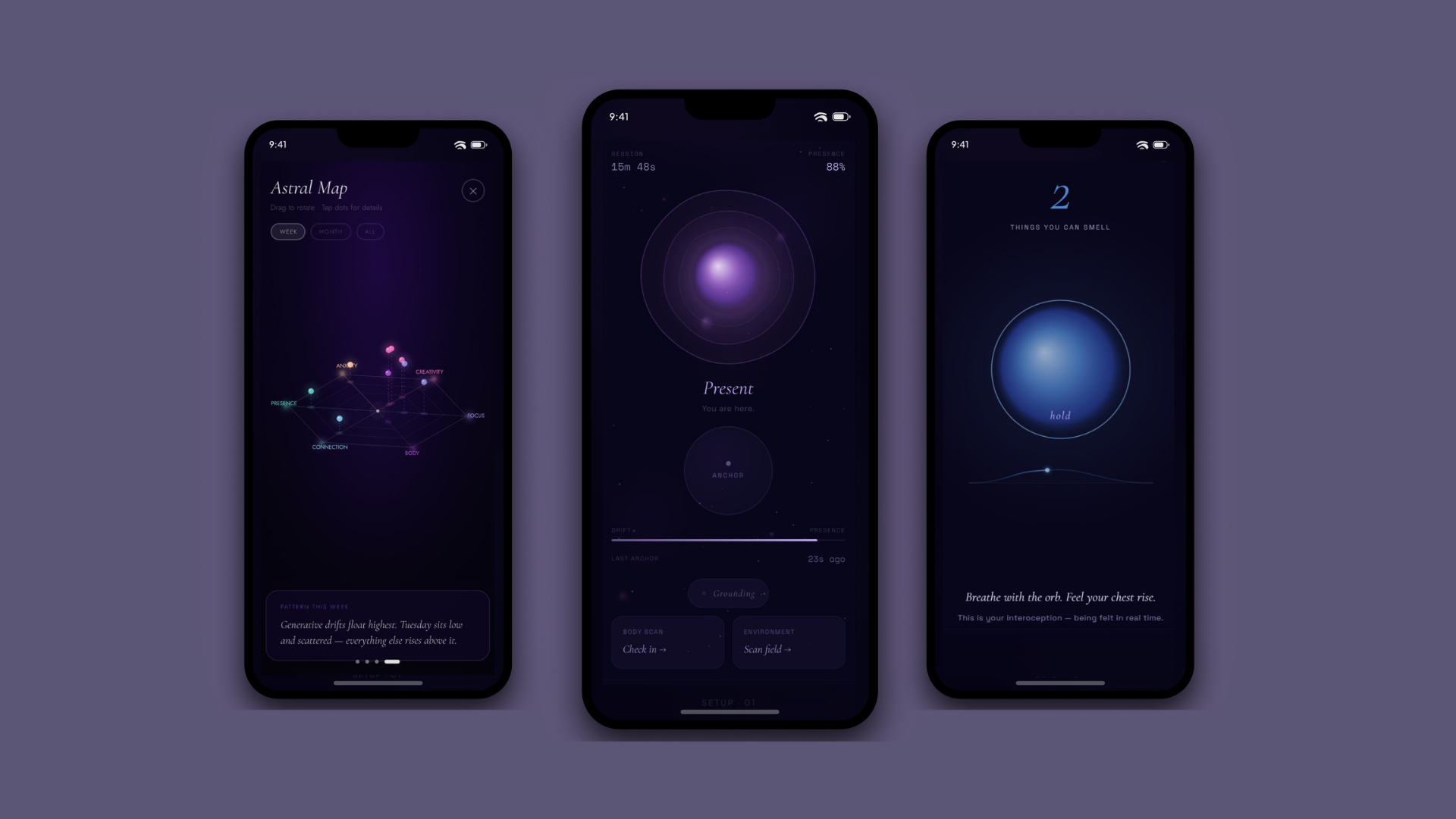
CalibrationChronoscape learns what you feel like when you’re focused, resting, and drifting — so it can tell the difference. No assumptions, just your baseline.
02
Guide to GroundingWhen a drift is detected, the environment gently alters sensory cues — light, sound, temperature — guiding you back without interruption or shame.
03
Post-Grounding ReflectionOn return, you tell Chronoscape how your body felt — not what you were thinking, just the residue. Over time this builds your personal drift vocabulary.
04
View Drift MetricsUsing passive physiological signals, Chronoscape maps the depth, duration, and quality of each drift in real time — so you can see your patterns, not just feel them.
Next steps
From speculative to real.
Past the hackathon, Chronoscape could integrate passive signals — typing cadence, scroll speed, micro-pause patterns — to detect mind-wandering states without self-report. Pairing chronoception data with calendar context could surface insights automatically: your constructive daydreaming peaks mid-morning; your rumination spikes after back-to-back meetings.
Takeaways
Chronoscape taught me how to design around something invisible. When the input itself is a feeling, every UI decision carries extra weight — the wrong friction kills honesty, the wrong visual makes the data feel foreign instead of personal.
The most important lesson: speculation doesn’t mean fiction. The best speculative design is grounded in a real human truth — and time perception is as real as it gets.
See next